Home/Blog/Karting Suit Sizing Guide

Karting Guide

Karting Suit Sizing
Junior, Senior & Shifter

CIK Level 2 explained, junior and cadet fit, when shifter kart drivers need the upgrade, and how to measure a kid (or yourself) for a custom karting suit that lasts a full season.

← Back to Blog

Custom Karting Suit Sizing — Junior, Senior, Shifter & CIK Level 2 Explained

What changes between a 9-year-old's cadet kart suit and an adult's shifter kart suit — and why karting suits are not just smaller racing suits.

Karting is its own world. Walk through a WKA Manufacturers Cup paddock, an SKUSA Pro Tour weekend, or a Rotax Max regional, and you'll see a hundred karting suits — all the same general shape, all SFI- or CIK-labeled, and all spec'd for a different job than what they look like. The 9-year-old in the cadet class is wearing a suit built for abrasion resistance and growth room. The 38-year-old shifter kart driver next to them is wearing a suit built for harness clearance, range of motion at the steering wheel, and surviving a full weekend of 100+ lap sessions in 90°F heat.

This guide breaks down the karting suit world by class — junior, cadet, senior, and shifter — what changes in the spec, what every sanctioning body actually requires, and how to measure correctly so the suit lasts a full season. If you're buying for a kid, special attention to the section on growth room. If you're buying for yourself, special attention to harness compatibility for shifter.


Why a Karting Suit Is Not a Smaller Racing Suit

A common mistake — especially among parents buying their first cadet suit — is assuming a karting suit is just a small auto racing suit. It's not. The primary injury risk in karting is abrasion, not fire. Karts carry small fuel loads, run cooler than methanol-burning sprint cars, and the cockpit is open with no enclosed fire-pool risk. What hurts you in karting is the slide across asphalt or grass after going off, the contact with a tire barrier at speed, and the wear-and-tear of a long weekend.

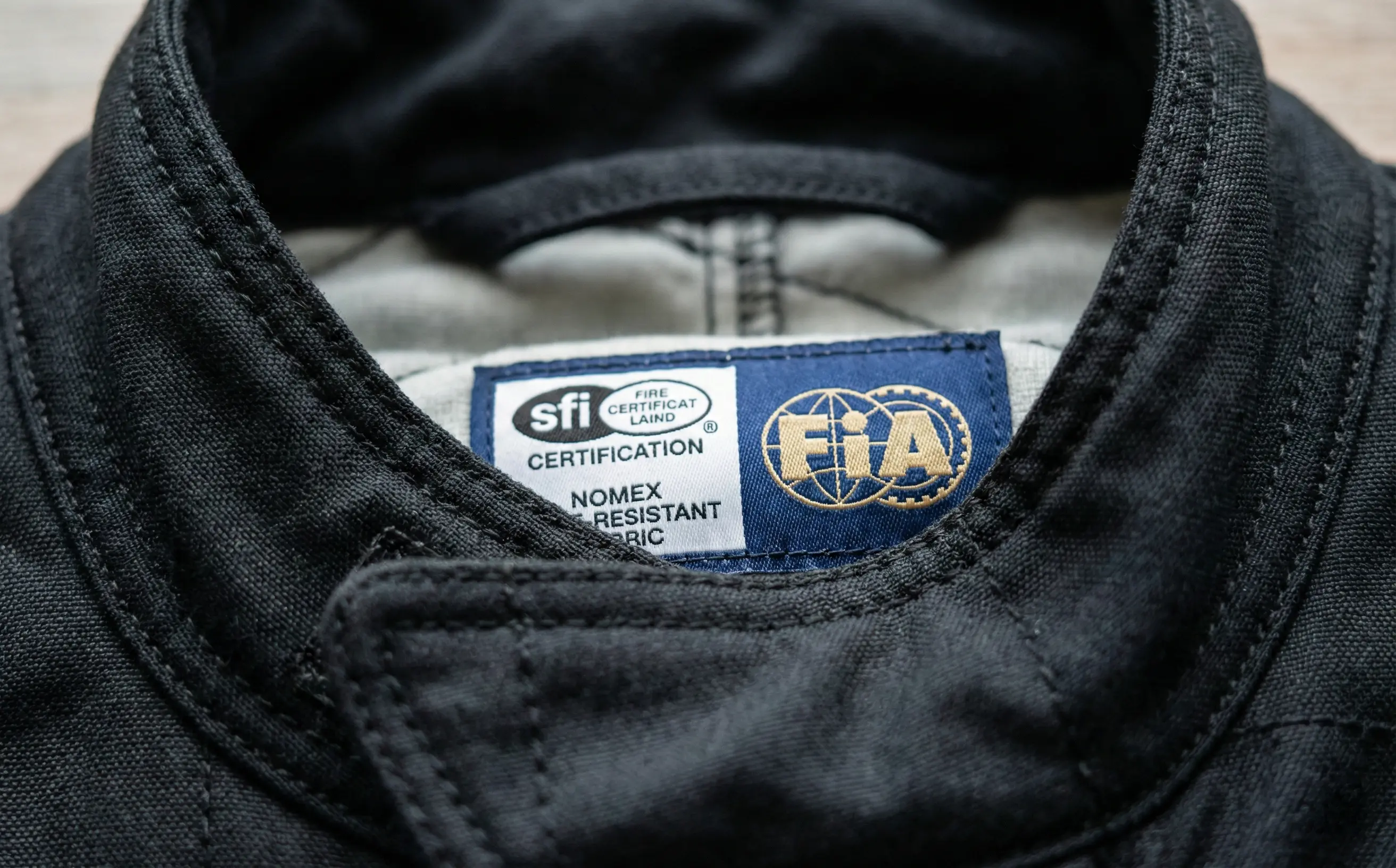
That's why karting suits are built around a different testing standard — CIK (Commission Internationale de Karting) — that prioritizes abrasion resistance over thermal protection. CIK suits include fire-retardant fabrics meeting the SFI 3.2A/1 baseline, but the construction emphasizes:

  • Tightly-woven outer fabric for slide resistance
  • Reinforced panels at shoulders, elbows, and knees (the contact points in a flip)
  • Stretch panels at the underarm and crotch for free range of motion at the wheel
  • Full-coverage sublimation printing for team graphics without raised embroidery seams that catch on a sliding surface

An auto racing SFI 3.2A/5 multi-layer Nomex® suit will pass karting tech in any series. It's also overkill — too hot, too restrictive, and built for a fire risk karting doesn't have. The right tool is a CIK Level 2 karting suit.

CIK Level 1 vs CIK Level 2 — What Each One Means

CIK certifies karting suits in two levels:

  • CIK Level 1: Entry-level. Single-layer abrasion-resistant fabric with fire-retardant treatment. Suitable for indoor karting, low-speed practice, and grassroots arrive-and-drive programs.
  • CIK Level 2: Competition standard. Multi-layer construction with abrasion-resistant outer shell, fire-retardant inner liner, and reinforced impact zones. Required by virtually every competitive karting series in the US, including WKA Manufacturers Cup, SKUSA Pro Tour, Rotax Max Challenge USA, and IAME USA East/West.

If you're racing anything competitive — meaning your kart number gets called over the PA and you're going for a podium — buy a CIK Level 2 suit. Level 1 looks like a savings until you fail tech at your first regional event and have to buy the right suit anyway.

For the broader SFI rating discussion across racing disciplines, see our SFI rating-by-class guide.

Junior & Cadet (Ages 8–12) — What to Look For

Cadet classes (Kid Kart, Micro Swift, Mini Swift, Mini ROK) run drivers age 5–12. Junior classes (Junior Swift, Junior ROK, Rotax Junior) typically run ages 12–15. The suit spec for both:

  • CIK Level 2 minimum. Same standard as adult karting.
  • Sublimated graphics over embroidery. Embroidered seams are abrasion points and add cost; sublimation prints into the fabric.
  • Built-in stretch panels at the knees. Kids grow. A suit with knee stretch panels stays in service longer.
  • Adjustable cuffs. Wrist and ankle Velcro cuffs let the suit grow with the driver instead of binding within a season.
  • Color choices that hide dirt. Brand red, deep blue, black. White looks great on day one and like a disaster by Sunday afternoon.

Parent Tip — Growth Room

When sizing a junior karting suit, order the size that fits today's shoulders and chest correctly — not the size up. Length adjusts with stretch panels and cuff Velcro; shoulders and chest don't. A too-big suit binds wrong and creates safety problems. Most juniors get 1 to 1.5 seasons out of a properly-fit suit. Plan to replace, not over-order.

Senior Karting (TaG, Briggs, KA100) — Same Standard, Different Sponsors

Senior categories — TaG Senior, Briggs LO206 Senior, KA100 Senior, IAME X30 Senior — all use the same CIK Level 2 standard as junior. What changes at senior level:

  • Sponsor logo placement matters. Senior drivers usually have a meaningful list of sponsors. Logo placement is real estate that affects sponsor renewal. Plan the layout with your sponsors before submitting the mockup.
  • National-level events demand sharper graphics. Watch SKUSA Pro Tour or USPKS footage — the top-running drivers have sharp, professional, brand-consistent graphics. That's not luck; that's deliberate design with a custom shop.
  • The wear pattern is different than junior. Adult drivers run more laps per weekend (longer Saturday qualifying, longer Sunday finals). Reinforced shoulder panels and a moisture-wicking inner liner matter more.

Shifter / KZ / IAME X30 Shifter — When You Actually Need the Upgrade

Shifter karting changes the suit conversation. Shifter karts (KZ, IAME X30 Shifter, Stock Honda Moto Shifter) are faster, hotter, and physically more demanding than non-shifter classes. The driver works a 6-speed gearbox with their right hand on the steering wheel paddle, manages a clutch on the left side, and runs lap times that approach Formula Ford on a road circuit.

Suit upgrades that matter for shifter:

  • Reinforced abrasion panels at the right shoulder. Shifter driving puts the right shoulder under sustained load against the seat.
  • Cooler inner liner. Shifter sessions run longer than sprint karting, the engine sits closer to the driver, and the work rate is higher. A breathable mesh inner liner with moisture-wicking technology drops core body temp meaningfully.
  • Stretch panel at the inner elbow. The constant paddle-shift motion fatigues the right inner elbow first — a stretch panel relieves binding.
  • Reinforced collar with breathable mesh. Shifter drivers wear neck restraints or high-collar helmets; the suit collar has to clear without choking.

Some series — usually SKUSA SuperNationals and international KZ — also require SFI 3.2A/1 with abrasion certification on top of CIK Level 2. Confirm with your specific series before ordering.

How to Measure for a Custom Karting Suit (Adult or Kid)

Off-the-rack karting suits are cut for a 50th-percentile driver. If you're not exactly that — and most kids aren't, given growth patterns — the suit binds and the wear pattern accelerates. Custom-measured karting suits cost roughly the same as mid-tier off-the-rack and last meaningfully longer. The seven measurements that matter:

  • Chest (around fullest part): drives the upper body fit and harness clearance
  • Natural waist (above hip bones): drives where the suit sits and the inseam length
  • Hip (around widest point): drives the lower-body fit
  • Shoulder seam to seam (across back): drives the shoulder-cuff length and harness pad position
  • Outseam (waist to ankle bone): drives the leg length
  • Inseam (crotch to ankle): driver fit at the inner thigh — critical for shifter
  • Sleeve length (shoulder to wrist): drives cuff fit; under-spec'd here and the gauntlets pull free in a slide

For the full measurement walkthrough, see our custom fit tips post. The principles for karting fit follow auto racing closely with one exception: karting suits need more shoulder mobility because of the constant steering input.

WKA, SKUSA, Rotax Max — Sanctioning Body Requirements

Every major US karting sanctioning body specifies CIK Level 2 as the floor, but each has its own technical bulletin variations. Current as of 2026:

  • WKA (World Karting Association): CIK Level 2 minimum for all national-level events. Manufacturers Cup, Roadracing Series, and Speedway Dirt Series all use the same baseline.
  • SKUSA (Superkarts USA): CIK Level 2 for all sanctioned events. SKUSA SuperNationals adds additional safety equipment requirements for KZ class.
  • Rotax Max Challenge USA: CIK Level 2 for all regions; junior categories specifically check fit at registration.
  • IAME USA East / West: CIK Level 2; tech inspectors are strict about suit condition for junior categories.
  • USPKS (US Pro Kart Series): CIK Level 2 minimum.
  • Local tracks (arrive-and-drive, weekly programs): Some accept CIK Level 1 for grassroots competition. Confirm with track tech before assuming Level 1 passes.

When to Replace a Karting Suit (Especially Junior)

Five signs the suit is done:

  • Junior driver has grown more than 1.5 inches at the chest or shoulder since the suit was measured
  • Abrasion patches at the elbows or knees show through to the inner liner
  • The CIK Level 2 label is faded or detached (no label = no tech pass)
  • Sublimation graphics show visible cracking — usually means UV degradation has compromised the outer shell
  • The suit binds when the driver reaches for the wheel — common after a growth spurt for juniors, common after a season for adults if measurements were off

Junior karting suits typically last 1 to 1.5 seasons before a growth spurt makes them unsafe. Plan for the cycle — don't try to stretch one suit across two seasons.

Common Karting Suit Mistakes

Six things we see in karting paddocks, in rough order of how often:

  • Buying CIK Level 1 to save money on a junior who's about to enter Cadet competition. The suit fails tech at the first regional. Always Level 2 for any sanctioned series.
  • Buying one size up for a junior expecting growth. Shoulders and chest don't stretch — the kid races bound for a season, then grows out anyway.
  • White or pastel exterior colors. Looks pristine on day one. Looks battle-tested for the wrong reasons by Saturday afternoon practice.
  • Embroidered sponsor logos over sublimation. Embroidery seams catch on slides and add cost without proportional sponsor value.
  • Inheriting a suit from an older sibling. Karting custom-fit is unforgiving — different bodies need different suits even at similar sizes.
  • Treating the suit like a costume between events. CIK fabrics need to dry flat, away from direct UV, hung not folded. Wadded in a kart bag for two weeks degrades the fire-retardant treatment.
Custom · CIK Level 2 · Made in USA

Custom Karting Suits — Junior, Senior & Shifter

HS Race Gear builds custom CIK Level 2 karting suits with full-coverage sublimation, reinforced abrasion panels, and stretch panels for shoulder mobility at the wheel. Junior, cadet, senior, TaG, and shifter fits. Team batch pricing at 3+ suits.

NEWSLETTER

Subscribe to our newsletter

Home
Account
Shop
0
Cart
SIDEBAR ACCOUNT